
Every Day with AAC Series (2 of 4): AAC Goes Trick-or-Treating
Oct 11, 2026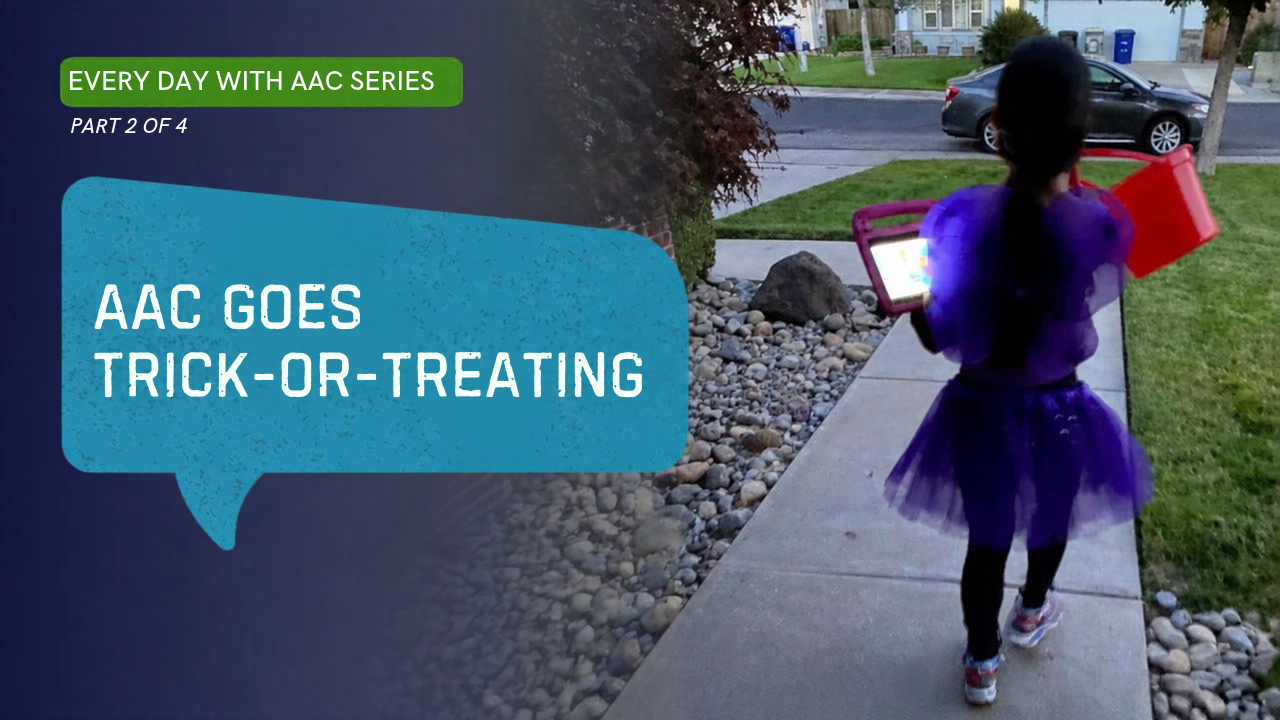
October is AAC Awareness Month, a time dedicated to celebrating Augmentative and Alternative Communication, the tools, strategies, and systems that help nonspeaking and minimally speaking individuals share their thoughts, needs, and ideas with the world. While we believe in all forms of communication, we'd like to highlight the occasion by publishing a four-part series called Every Day with AAC, exploring how families can weave AAC into the moments that already fill their days. This second post looks at how Halloween, and the weeks leading up to it, create some of the most natural AAC modeling opportunities of the year.
Halloween has a lot going for it from an AAC standpoint. The whole night is basically one repeating sequence: walk up, say something, get something, move on. Over and over again. For our students, that kind of repetition is actually really valuable. The vocabulary is the same at every door, the interaction is short, and there is genuine motivation involved, whether that's the candy, the costumes, the sensory experience of being outside at night, or just the novelty of the whole thing.
My daughter went trick-or-treating for the first time a couple of years ago, and the preparation we did throughout October is a big part of why it worked. I wrote about all of that in our post "How to Get Your Kid Ready for Halloween," which covers everything from decorating and books to social stories and choosing a costume. Here, I want to zoom in specifically on the AAC piece, because there's a lot to work with.
And if Halloween isn't your thing or your student's thing, that's completely fine. The same ideas apply to any event with a predictable routine and real people to communicate with. Trunk-or-treat events are also worth mentioning here, as they tend to be more contained, better lit, and provide a safer environment, which can make the whole experience more accessible for some students.
Build a Page Before You Go
On your student's device, set up a simple Halloween page before October 31st. You don't need a lot of words on it. "Trick or treat," "thank you," "more," "all done," and "go" will cover most of what comes up during the night. In our AAC program, we have Trick-or-Treat templates you can download and adapt for your student's device and needs. Having the vocabulary already there, already practiced, makes a real difference when you're standing on a neighbor's porch and the moment is actually happening.
We used Halloween-themed words during our regular sessions throughout October. My daughter typed Halloween vocabulary on her device during lessons, which wasn't just AAC practice; it was also building familiarity with the whole concept of the holiday before we ever left the house.
Practice the Sequence at Home
A week or two before Halloween, do a simple run-through at home. Knock on a door (a wall, a cabinet, whatever), model "trick or treat" on the device, and have someone on the other side respond with a little something. Keep it short and low-key. You're not drilling; you're just making the sequence feel familiar before it happens for real.
We also used a social story about trick-or-treating all month long, worked into our regular sessions. Repeat, repeat, repeat. By the time Halloween night came around, my daughter had seen the sequence so many times that it didn't feel new. And familiar is where our students tend to communicate best.
At the Door
This is where all that prep actually pays off, because this is a real interaction, not a practice one. Someone is actually waiting. There is actually something to say.
I carried my daughter's device for her on the night since she wasn't used to holding it yet. As she approached each door, I modeled "trick or treat" on the device right before she got there. After the candy went in the bucket, I modeled "thank you." She did it herself a couple of times by the end of the night, which was honestly one of those moments.
One tip that helped us a lot: wait until the rush clears before approaching a door. Groups of kids move fast and aren't always patient. Going up when it's slow gives your student more time and less pressure, and most neighbors are happy to wait an extra beat.
After You're Home
Once you're back and the bucket is on the table, there are still AAC moments left if you want them. Sorting through the candy together is a natural, calm way to use "want," "like," and "more." My daughter doesn't eat candy, so for us it was just about looking through everything, but if your student is motivated by the treats, sorting can double as a communication activity pretty easily.
For the full picture of how we prepared for Halloween, from the costume situation to the familiar bike route we used as our trick-or-treat path, head over to "How to Get Your Kid Ready for Halloween."
In Part 3 of Every Day with AAC, we're looking at how AAC can help your student identify and express their emotions.
Nonverbal Autism Homeschool enrollment is currently open!
Stay connected with news and updates!
Join our mailing list to stay updated on Nonverbal Autism Homeschool courses, special events and new blog posts. You'll also receive free curriculum, inspirational messages, autism parenting hacks and more!
We hate SPAM. We will never sell your information, for any reason.
