
Let’s Talk About Creative Writing: A Method That Works
Nov 01, 2026
Learning to write is one of those skills that can feel overwhelming from both sides of the table. For the parent teaching it and for the student being asked to do it. Where do you even start? A blank page doesn’t tell anyone what’s expected, and “just write something” isn’t instruction.
In this post we’re going to walk through a method for teaching creative writing that starts with modeling complete sentences before your student is ever asked to produce one independently. We’ll focus first on an approach for those using our 3rd grade program that Heather and special education teacher Ken Sims discussed in our September Q&A session. And if your student isn’t in the 3rd grade program yet, don’t click away. At the end we’ll show you how to apply the same idea using the sentence strips included in our program, so you have a place to start building those skills now.
Modeling Comes First
The core idea behind what Heather and Mr. Sims discussed in the September Q&A was simple: before you ask a student to write, show them what writing looks like.
Start with a topic and give your student choices. Heather uses a dry erase board with four options — for persuasive writing, something like “What is the best dessert and why?” works well. Present the choices, let your student pick, and then you write out the four-sentence paragraph for them based on the answers you’ve just gone over together. The student doesn’t have to come up with the details on their own. As Mr. Sims puts it, “When kids have concrete models, it helps them in the long run on how to do things.”
Next, read the paragraph together one sentence at a time. Repeat this process and writing activity over the course of several weeks. Mr. Sims has worked with students on the same material for months, returning to it again and again until it becomes genuinely familiar.
Once that paragraph feels familiar, then you break it up. Print it out, cut the sentences into strips, and put them on the table. Now the task is to put them back in the right order. The paragraph isn’t a mystery anymore because they’ve already seen it whole. They’re just reconstructing something they know. That shift in cognitive load is what makes it work.
Not in the 3rd Grade Program Yet?
The same principle works for students who are just starting to work with written language, and sentence strips make it easy to start building those skills now.
Each sentence strip includes a complete sentence paired with a set of image choices. The student reads the sentence and selects the photo that matches what it describes. For “I love to drink hot cocoa,” you might offer a picture of hot cocoa alongside another one of the photo options. Read the sentence together first, then present the choices. Start with two images and add more options as your student gets comfortable with the activity.
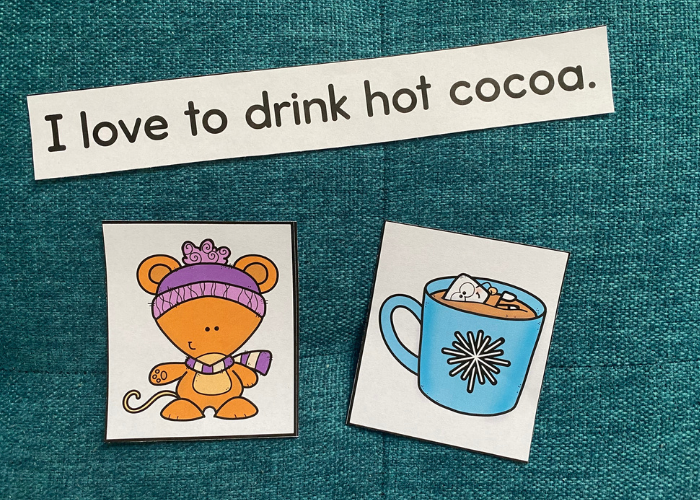
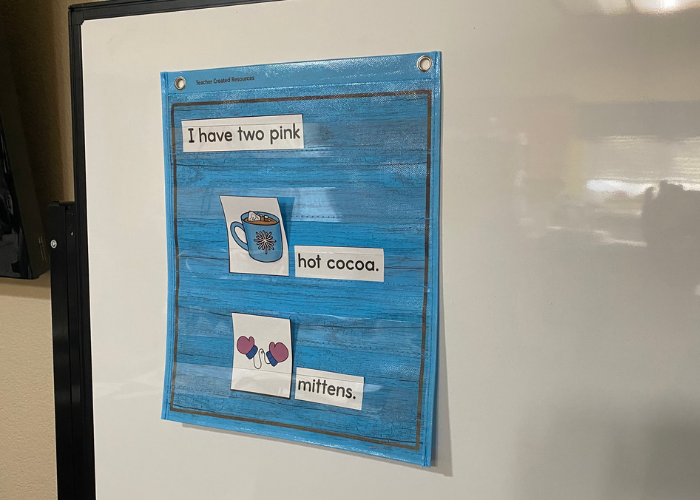
Then, when your student is ready, come back to it with a different purpose. Cut the strip so that one key word — usually the subject or the word the image is showing — is separate. Now the task is simply to place that piece back where it belongs. They already know the sentence. They just need to complete it.
Follow Your Student’s Lead
Both approaches work on a whiteboard, on the floor with cut-up paper strips, or on a table with laminated word cards. Some students will engage more when they can physically move the pieces. Others might do better typing the missing word on their AAC device or building the sentence on a screen. All of those are valid.
The method is the model. However your student accesses it best, start with the whole sentence, make it familiar, and then invite them to interact with the parts.
Writing is a skill that builds slowly, and that’s okay. The goal right now isn’t a finished paragraph or a perfect sentence. It’s giving your student enough repetitions with language that it starts to feel like something they can work with.
Nonverbal Autism Homeschool enrollment is currently open!
Stay connected with news and updates!
Join our mailing list to stay updated on Nonverbal Autism Homeschool courses, special events and new blog posts. You'll also receive free curriculum, inspirational messages, autism parenting hacks and more!
We hate SPAM. We will never sell your information, for any reason.
