
Every Day with AAC Series (3 of 4): Feelings Are Part of the Lesson Too
Oct 18, 2026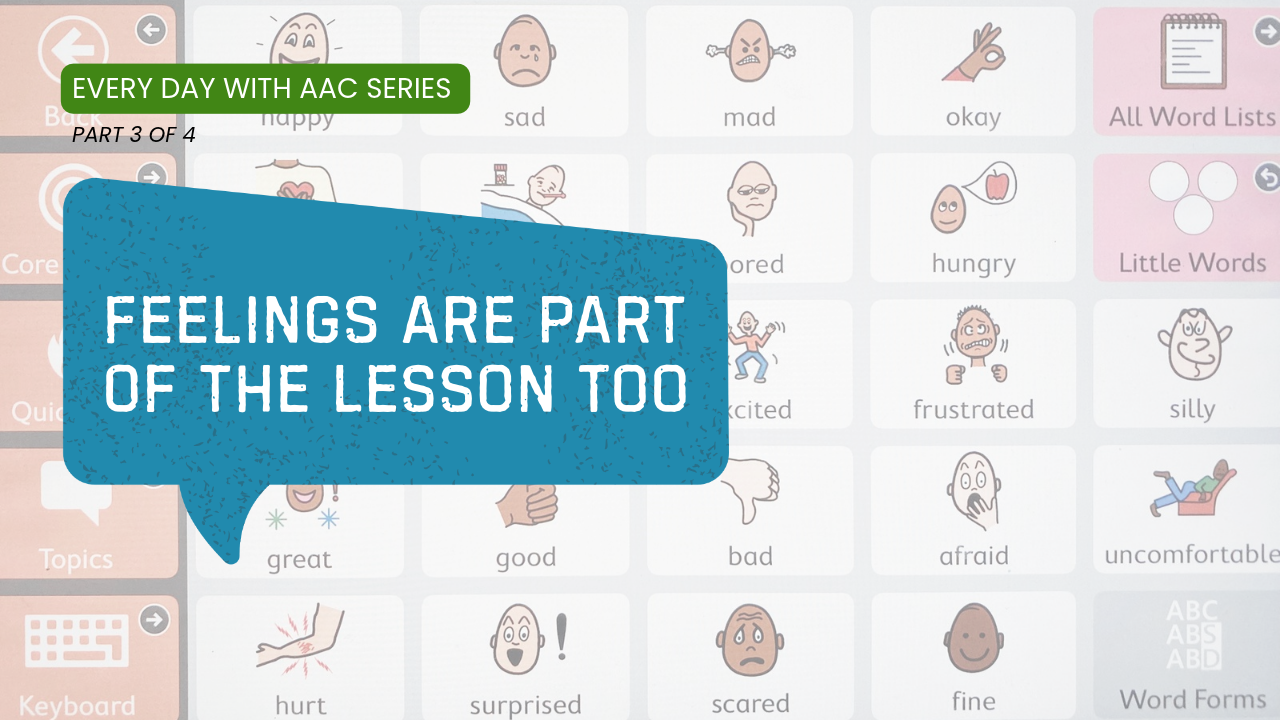
October is AAC Awareness Month, a time dedicated to celebrating Augmentative and Alternative Communication, the tools, strategies, and systems that help nonspeaking and minimally speaking individuals share their thoughts, needs, and ideas with the world. While we believe in all forms of communication, we'd like to highlight the occasion by publishing a four-part series called Every Day with AAC, exploring how families can weave AAC into the moments that already fill their days. This third post looks at how AAC can help your student identify and express their emotions — and why that matters just as much as any academic skill.
Teaching feelings isn't a traditional academic skill, and it won't show up on a lesson plan the same way math or reading does. But it might be the thing that makes everything else work better. When your student has words for what they're feeling — frustrated, overwhelmed, done — you can actually respond to that. Without that vocabulary, a hard session can turn into a hard hour, and sometimes a hard day, without either of you really knowing what went sideways.
Why Emotions Belong in AAC
Most AAC devices and programs have a feelings or emotions category somewhere in them, but it often doesn't get the same attention as requesting vocabulary or core words. That's understandable, since we're usually focused on getting our students to communicate wants and needs first. But emotions are communication too, and they're worth making time for.
PrAACtical AAC, a well-known resource for SLPs and families, puts it clearly: don't assume that emotion vocabulary is inappropriate just because an individual has lower language levels or cognitive delays. Our students have feelings, and they deserve words for them.
That means going beyond "happy" and "sad." Words like frustrated, worried, bored, and proud give your student a much more complete picture to work with. And once they can name a feeling, the next step is giving them something to do with it. "I need a break." "Can you help me?" "I don't like this."
Start Simple and Model Often
You don't need a dedicated emotions lesson to work on this. The easiest entry point is modeling how you feel throughout the day, using the device just like you would any other vocabulary.
If you're tired in the morning, say so on the device. If something is funny, model "happy" or "excited." If a plan changes and your student seems thrown off, narrate: "I know, that feels frustrating." The goal isn't drilling; it's showing them that feelings have words and that those words are right there on their device.
One approach that works well is starting with a small set of emotion words and adding more gradually. Avaz, an AAC app company, notes that adding too many emotion words at the beginning can be confusing and overwhelming. Pick three or four that come up most often in your student's day (for many families that's some version of happy, frustrated, tired, and all done) and get comfortable with those before expanding.
Weave It Into What You're Already Doing
You don't have to carve out extra time for this, because emotion modeling fits naturally into the routines you already have.
At the start of your session, do a quick check-in. Pull up the feelings page, model what you're feeling, and give your student a moment to do the same without pressure. Over time, this becomes a familiar ritual that sets the tone for the day and gives you a heads-up if they're coming in already frustrated or tired before the first activity even starts.
When something goes well, name it: "You did it! Happy? Proud?" When something doesn't go well, model that too — "That was hard. Frustrated." — because you're building a vocabulary that reflects real life, not just the good parts.
The Earlier, The Better
A younger student who learns to communicate "I'm overwhelmed" has a tool that will serve them for the rest of their life. An older student who hasn't had that practice may not have words for what's happening when emotions run high, and that gap can show up as behavioral challenges, shutdowns, or meltdowns that are hard for everyone.
(Jen here: This one is personal. My daughter is 13, and identifying and expressing emotions is genuinely hard for her. I don't know that earlier practice would have fixed everything, but I think we'd have a clearer picture of what's going on during the hard moments, and that alone would make a difference.)
If you're just starting out, pick one or two feeling words that come up most in your student's day and go from there. Model them when the moment is real, not just when it's convenient. Over time, those small moments add up to something that matters a lot.
In Part 4, the final post in our Every Day with AAC series, we're looking at how your student's device can double as a literacy tool, and how some of our own curriculum activities translate surprisingly well to the keyboard.
REFERENCES
Nonverbal Autism Homeschool enrollment is currently open!
Stay connected with news and updates!
Join our mailing list to stay updated on Nonverbal Autism Homeschool courses, special events and new blog posts. You'll also receive free curriculum, inspirational messages, autism parenting hacks and more!
We hate SPAM. We will never sell your information, for any reason.
