
Why Predictability Helps Autistic Learners Thrive
Mar 15, 2026
There is a moment most homeschool parents know well. You have the lesson ready. Your student was engaged yesterday. And then something is slightly off today — a different start time, a skipped step in the morning routine, a chair in a new spot — and the whole session unravels before it begins.
It is not defiance. It is not a bad day for no reason. It is a brain that genuinely depends on knowing what comes next.
For autistic learners, predictability is not a preference. It is a functional need that directly shapes their ability to participate, regulate, and learn.
What the Research Tells Us
Autistic brains tend to rely heavily on established patterns to interpret and navigate the world around them. When the environment is consistent, that cognitive load lightens. When it is not, the brain works overtime just trying to make sense of what is happening — leaving little bandwidth for learning.
Research published in Autism Research found that individuals with more autistic traits show a measurably stronger preference for predictable patterns across multiple contexts, from auditory sequences to decision-making tasks. This is not a quirk. It is a meaningful feature of how the autistic brain processes information.
Routines also support emotional regulation. When students know what is coming, anxiety drops. And when anxiety drops, learning becomes possible.
What This Looks Like in a Homeschool
Predictability in a homeschool setting does not mean a rigid, minute-by-minute schedule. It means giving your student a reliable framework they can count on.
A few things that make a real difference:
A consistent start. Beginning each school day the same way — same space, same opening activity, same sequence — signals to your student's nervous system that learning time is here. That signal alone can reduce resistance before the first lesson even begins.
A visual schedule. Visual schedules are one of the most well-supported tools in autism education. A 2024 literature review in the Journal of Autism and Developmental Disorders found strong evidence that visual schedules increase on-task academic behavior in autistic students when used consistently. Seeing the day laid out visually reduces the unknown, which reduces anxiety, which makes engagement possible.
Transitions Are Their Own Category
Moving from one activity to the next is genuinely hard for many autistic learners, and predictability helps here too.
Giving your student a heads-up before a transition — a verbal cue, a visual timer, a simple first-then board — provides that critical moment of preparation. It is the difference between being pulled out of something and being walked out of it.
Keep transition signals consistent. Use the same cue every time. The familiarity of the signal is part of what makes it work.
Here's What Worked For Me
When we first started homeschooling, I leaned into what was already working for my daughter in both school and therapies: checklists. She took to them right away, checking off each item as we moved through the day. I kept it visual and fun with a magnetic dry-erase board and rainbow-colored magnet stars as her way of marking things complete.
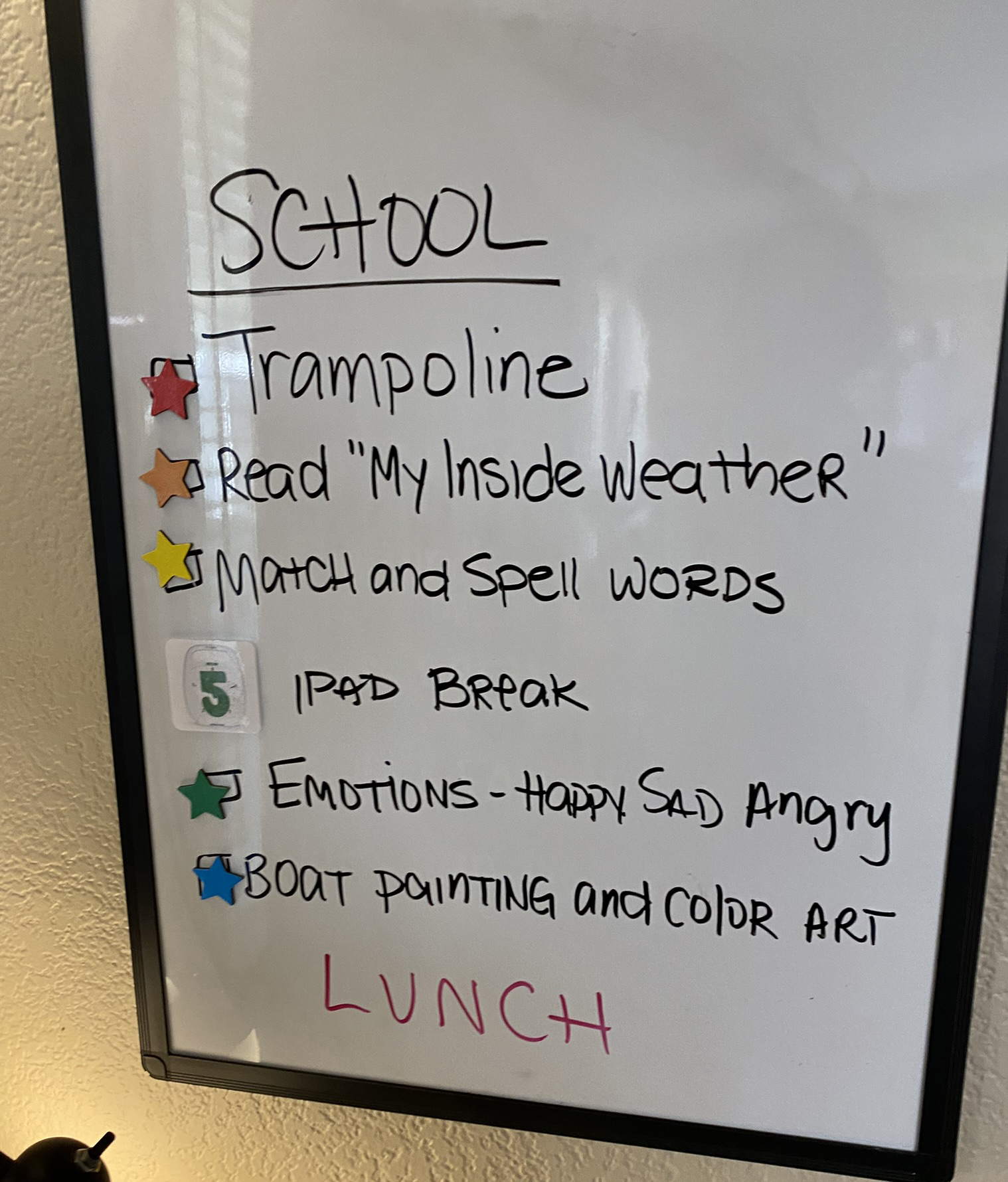
Over time, she started suggesting items to add herself. Usually a coloring activity made the list, and eventually she added Lunch as the last item every single day. That little routine worked beautifully for two years before I began making adjustments as she got older.
Start With One Thing
You do not have to overhaul your entire homeschool to build more predictability into your day. Start with one anchor — a consistent opening routine, a simple visual schedule for your core subjects, or a reliable transition cue for the hardest moment of your school day.
Small changes in structure create big shifts in regulation. And a regulated student is a student who can learn.
REFERENCES
-
Study examining the relationship between autistic traits and preference for predictability across music, perception, and decision-making tasks (Autism Research, Wiley).
-
Literature review evaluating the evidence base for visual schedules to increase academic-related on-task behaviors in autistic students (Journal of Autism and Developmental Disorders / Taylor & Francis).
-
Summary of visual activity schedules as an evidence-based practice, including outcomes across skill domains and age groups (Association for Science in Autism Treatment).
-
National Professional Development Center on ASD overview of visual supports as an evidence-based practice across preschool through high school age learners.
Nonverbal Autism Homeschool enrollment is currently open!
Stay connected with news and updates!
Join our mailing list to stay updated on Nonverbal Autism Homeschool courses, special events and new blog posts. You'll also receive free curriculum, inspirational messages, autism parenting hacks and more!
We hate SPAM. We will never sell your information, for any reason.
